Commercial & Industrial Water Damage Restoration
Everett Restoration Pros provides 24/7 commercial water damage restoration across South Everett, Paine Field (98204), and Casino Road, arriving within 60 minutes. Our certified technicians deploy large-loss extraction, LGR dehumidifiers, and thermal mapping to resolve warehouse floods, broken supply mains, and sewer backflows. We immediately isolate affected zones, extract standing water from concrete slabs, and prevent structural decay to keep your business running safely.
Emergency Commercial & Industrial Water Damage Response in South Everett (98204)
Commercial emergency flood response is available 24/7 in South Everett (ZIP 98204) with an average 60-minute dispatch time to halt business disruption and structural deterioration. Facilities operating along the Casino Road commercial belt, Highway 99 retail strip, and Paine Field industrial park handle high-volume operations where unscheduled downtime causes severe financial loss.
When pressurized pipes burst or stormwater overwhelms property drainage, our local emergency flood restoration team for warehouses and retail spaces deploys high-capacity truck-mounted vacuum units immediately. Fast industrial flood response in South Everett ensures standing liquid is extracted before moisture migrates deeper into subfloors, concrete slabs, and structural wall framing. If you need immediate emergency dispatch in adjacent commercial zones, our emergency water damage company in South Everett operates 24/7/365 across the entire 98204 ZIP code.
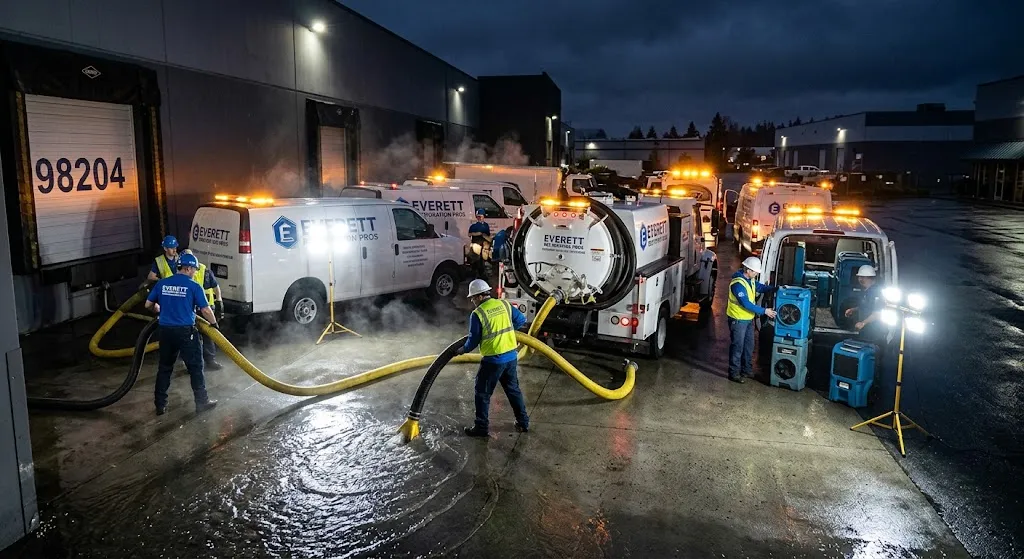
98204 COMMERCIAL MITIGATION
Commercial & Industrial Water Damage Challenges in 98204
Industrial properties in South Everett (98204) face complex moisture risks involving high-volume plumbing networks, expansive concrete slabs, and sensitive manufacturing machinery. Commercial properties and industrial facilities face unique physical and environmental moisture stresses due to building design, high-volume plumbing systems, and local topography.
High-Volume Main Leaks & Plumbing Bursts in Commercial Warehouses
Shut off the primary commercial water valve immediately and deploy high-CFM extraction to clear hundreds of gallons per minute, protecting concrete slab integrity and stacked rack inventory from wick moisture damage.
Heavy Equipment & Manufacturing Zone Flood Mitigation Near Paine Field
Deploy non-conductive drying protocols and containment barriers around CNC machinery and electronic control panels near Paine Field Airport to clear standing water from equipment pads and prevent tool rust or short-circuits.
Sewage Backups & Contaminated Water Inundation in Commercial Facilities
Isolate Category 3 sewage intrusions immediately, remove unsalvageable porous materials, extract contaminated liquids, and apply EPA-registered antimicrobial treatments to eliminate biohazards and airborne pathogens.
High-Capacity Bulk Water Extraction & Facility Flood Recovery
High-capacity bulk water extraction is executed using truck-mounted vacuum units and submersible trash pumps capable of pulling thousands of gallons of standing water per hour. Extracting free-standing liquid immediately is the most critical step in mitigating large-scale commercial property loss. Standard shop vacuums lack the suction power and tank capacity required to manage thousands of gallons of standing water on industrial concrete slabs.
Our restoration fleet arrives equipped with large loss extraction equipment, including truck-mounted vacuum plants and heavy-duty submersible trash pumps. These units deliver continuous high-CFM (cubic feet per minute) lift to pull standing water off polished concrete, epoxy flooring, carpets, and utility trenches. Achieving rapid subfloor moisture removal eliminates up to 90% of free moisture within the first few hours, reducing total drying time and preventing material delamination. For facility managers asking how to extract standing water from commercial warehouse spaces efficiently, truck-mounted extraction provides the fastest, most reliable bulk liquid removal available.
Precision Moisture Mapping & Psychrometric Dehumidification
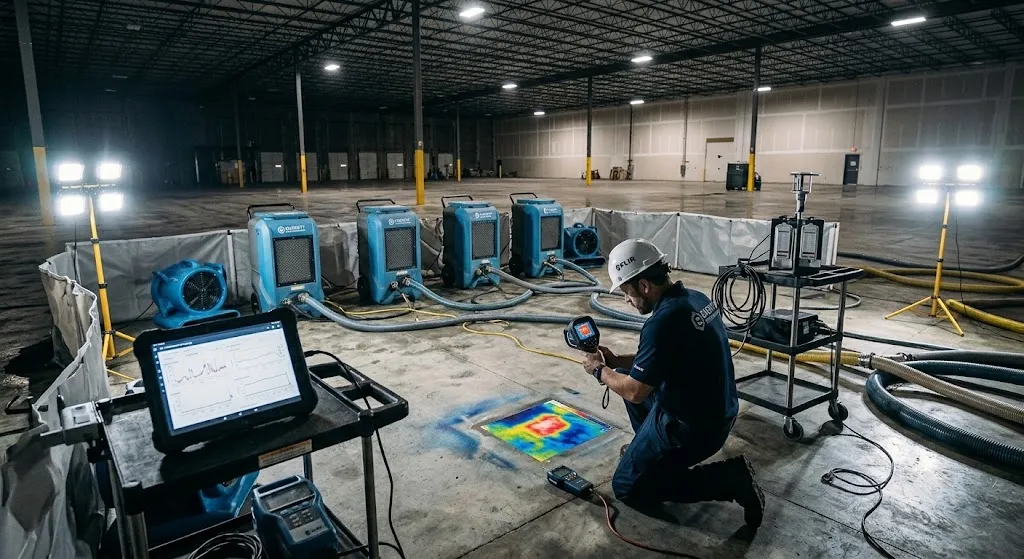
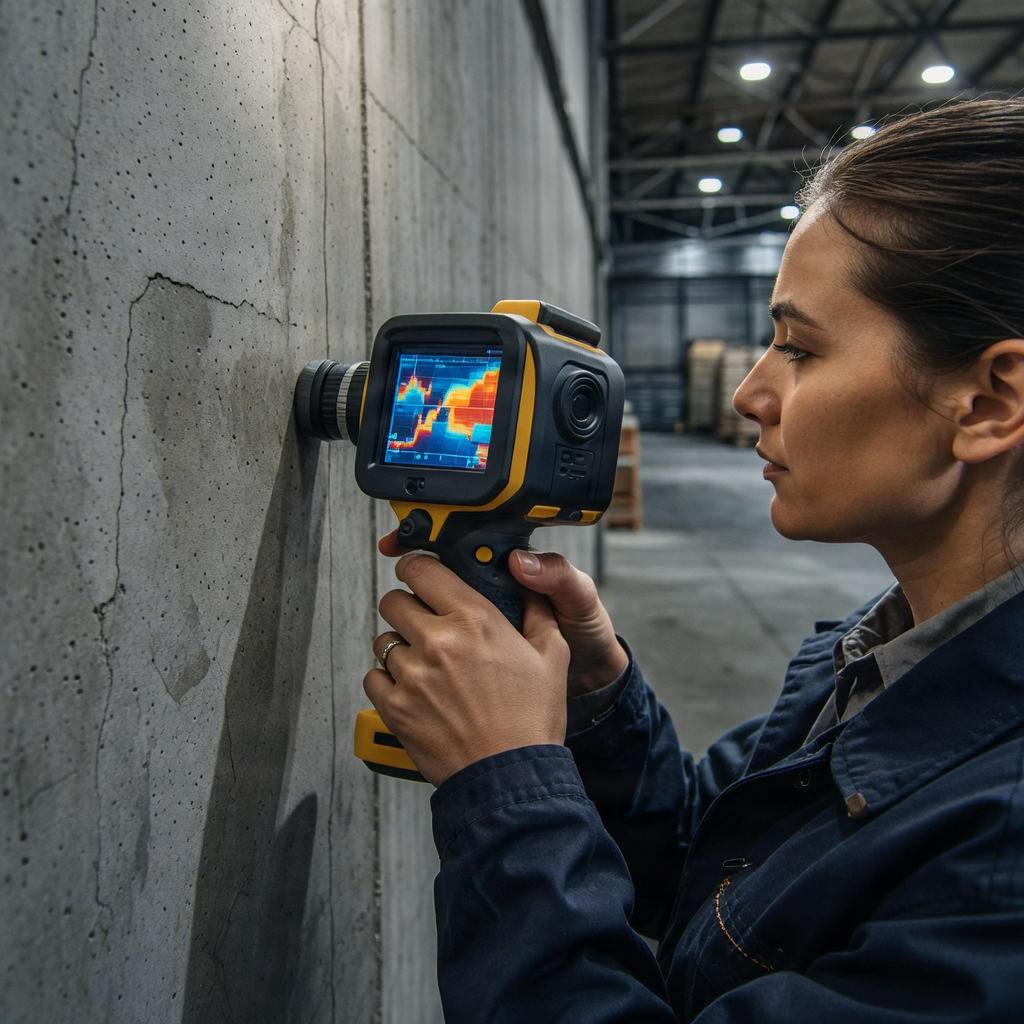
Precision moisture mapping uses FLIR thermal imaging cameras and digital meters to detect hidden moisture traps beneath concrete slabs and wall cavities. Water trapped inside concrete slabs, drywall framing, masonry seams, and under commercial tile cannot be identified by visual inspection alone. Unseen moisture leads to structural decay, compromised concrete integrity, and rapid microbial growth.
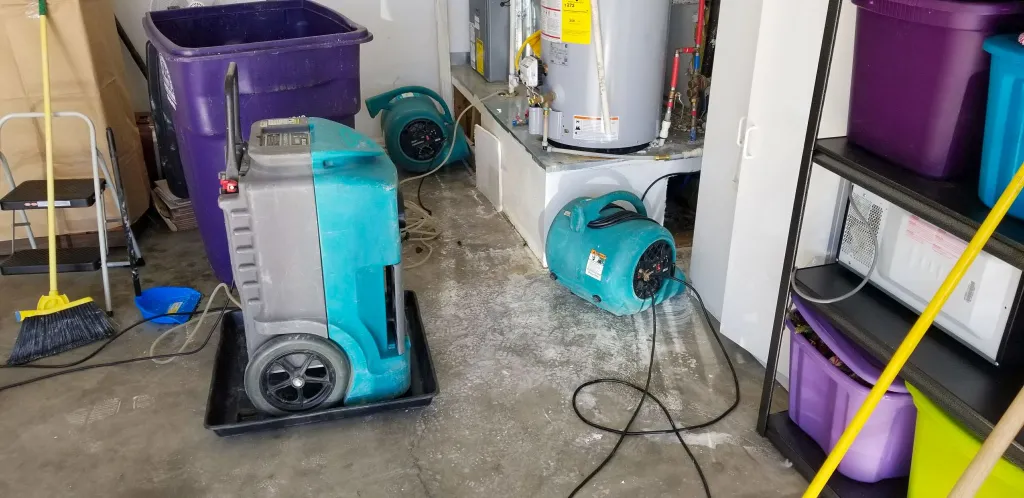
Technicians utilize non-invasive FLIR thermal imaging cameras and digital moisture meters during initial industrial thermal imaging leak detection to map exact moisture migration boundaries. Once moisture boundaries are identified, we deploy commercial dehumidification systems featuring industrial Low Grain Refrigerant (LGR) dehumidifiers and high-velocity axial air movers. Technicians record psychrometric drying logs daily, tracking relative humidity, ambient temperature, and grains per pound (GPP) to ensure structural materials are brought safely back to dry standard equilibrium.
Minimizing Operational Downtime for South Everett Businesses
Operational downtime is minimized by installing heavy-duty negative-pressure containment barriers to isolate drying areas while adjacent business bays stay open. Unscheduled business closures disrupt supply chains, client commitments, and revenue streams. Our commercial property water mitigation strategy focuses on keeping unaffected facility sections fully operational during the restoration process.
To isolate active drying zones, technicians install heavy-duty negative-pressure plastic containment barriers across affected warehouse bays or retail suites. Dust scrubbers and HEPA air filtration units prevent cross-contamination, dust migration, and odor transmission to operating business areas. Our team works flexible shifts, executing noisy extraction and equipment placement during off-hours so your business can continue daily operations safely.
Immediate Emergency Protocol
Facility managers should shut off main water supplies, disconnect power to wet areas if safe, elevate inventory, and contact emergency restoration services immediately upon discovering floodwater. Taking swift action before restoration technicians arrive on-site significantly reduces structural damage, inventory loss, and cleanup costs:
- Shut Off Main Water Line: Locate and turn off the primary commercial water shut-off valve immediately to halt active water flow.
- Isolate Electrical Power: Disconnect electrical circuit breakers serving wet floor zones or heavy equipment bays if it is safe to access dry breaker panels.
- Avoid Contaminated Floodwater: Keep personnel clear of standing water, ceiling sags, or sewer backups to prevent electrical shock or biological contamination.
- Elevate Inventory & Equipment: Move palletized stock, electronics, and movable equipment to higher ground or elevated racking systems.
Our 5-Step Commercial Water Restoration Workflow
Our commercial water restoration workflow follows a 5-step IICRC S500 process: thermal assessment, bulk extraction, antimicrobial sanitization, psychrometric drying, and final moisture verification. We follow a structured workflow to ensure complete structural drying, safety compliance, and seamless insurance settlement:
Thermal Assessment & Inspection
Technicians perform thermal camera inspections and moisture metering to map saturation throughout wall cavities, concrete slabs, and subfloors.
Heavy Bulk Extraction
Deploying large loss extraction equipment and truck-mounted pumps to remove standing liquid from warehouse floors and lower bays.
Antimicrobial Sanitization
Applying EPA registered antimicrobial treatments to damp structural surfaces to eliminate bacteria, fungal spores, and sewage contaminants.
Industrial Psychrometric Drying
Strategic placement of industrial LGR dehumidifiers and axial air movers, continuously monitored with daily psychrometric drying logs.
Final Moisture Verification & Insurance Billing
Verifying that all building materials have reached dry baseline standards and arranging direct insurance billing for commercial water damage in 98204 to simplify claim settlement.
Why Professional Water Damage Restoration Is Critical
Professional water damage restoration is critical because trapped concrete moisture and structural humidity cause mold growth, concrete spalling, and wood rot within 24 to 48 hours. Attempting to dry commercial facilities using basic floor fans or light vacuums allows water to remain trapped deep inside concrete slabs, wall studs, and insulation. In the humid maritime climate of the Pacific Northwest, unresolved moisture creates an ideal environment for toxic mold colonization within 24 to 48 hours.
Professional mitigation relies on commercial building moisture control and calibrated psychrometric principles to draw deeply bound water out of dense structural materials. Understanding the overall cost of industrial water damage cleanup near Paine Field reinforces the value of prompt restoration: professional structural drying prevents permanent concrete spalling, wood framing rot, costly inventory destruction, and insurance claim denials caused by delayed mitigation.
Service Coverage Across South Everett & Industrial Corridors
Everett Restoration Pros provides 24/7 rapid emergency restoration across all major commercial centers, industrial parks, and retail corridors within ZIP code 98204:
Paine Field Industrial District & Airport Perimeter
Casino Road Commercial Belt & Retail Outlets
Twin Creeks Business & Shopping Corridor
Holly Corridor & West Casino Road Industrial Facilities
Highway 99 Commercial & Auto Dealership Zone
South Everett Industrial Parks & Warehouses (ZIP 98204)
Frequently Asked Questions
How fast can emergency water damage teams respond to industrial facilities in South Everett 98204?
Emergency restoration teams arrive on-site within 45 to 60 minutes for commercial extraction calls across South Everett, Paine Field, and Casino Road (ZIP 98204), operating 24 hours a day, 365 days a year.
How do you extract standing water from large commercial warehouses near Paine Field?
Can your commercial flood restoration team operate without shutting down our entire facility?
Yes, we install heavy-duty negative-pressure containment barriers to isolate affected work zones, allowing unaffected warehouse sections and offices to remain open while structural drying equipment runs safely off-hours.
How do you clean Category 3 sewage backups in commercial South Everett buildings?
Category 3 sewage backups are sanitized by isolating contaminated zones, extracting biohazard liquids, removing unsalvageable porous items, and applying EPA-registered antimicrobial treatments to disinfect all structural surfaces thoroughly.
What are the main cost factors for industrial water damage cleanup in Paine Field?
Industrial restoration costs depend on total water volume, contamination level (Category 1 clean water vs. Category 3 sewage), affected square footage, and total drying time required for structural concrete and framing.
Do you bill commercial property insurance directly for water damage cleanup in 98204?
Yes, we complete detailed thermal moisture mapping reports, maintain daily psychrometric drying logs, and bill your commercial insurance carrier directly to streamline claim settlement.
How does commercial structural dehumidification work on large concrete floors?
Commercial structural dehumidification works by deploying high-capacity LGR dehumidifiers alongside high-velocity axial air movers to create balanced psychrometric conditions that draw deeply bound moisture out of porous concrete slabs and structural wood framing.